Liane Paonessa
Director, AP Strategic Communications, Program Communications, Engagement and Reach, College Board
Published
September 17, 2026
New research from College Board® and the U.S. Chamber of Commerce Foundation points to the same conclusion from two different data sets. The U.S. Chamber Foundation's 2026 Civic and Economic Literacy Survey finds that Americans' civic knowledge remains low, yet optimism that the country's problems can be fixed remains high, especially among teens. College Board's research on the high school graduating class of 2025 finds a parallel pattern: young people report strong interest in their communities and in staying informed, but that interest narrows considerably when it comes to formal political engagement. Closing the gap between optimism and civic knowledge, and habits needed to act on it, is where business, education, and policy leaders have the clearest opening.
The Optimism Gap
Teens, in particular, remain more hopeful that the country's problems can be fixed than adults. College Board's research points to a similar pattern: young people show strong interest in their communities and in staying informed, even as their interest in formal political engagement lags well behind. Together, the two data sets point to an optimism gap that runs in an encouraging direction.
Civic and Economic Literacy: Key Findings at a Glance
Civic Health Snapshot: Adults vs. Teens (2026)
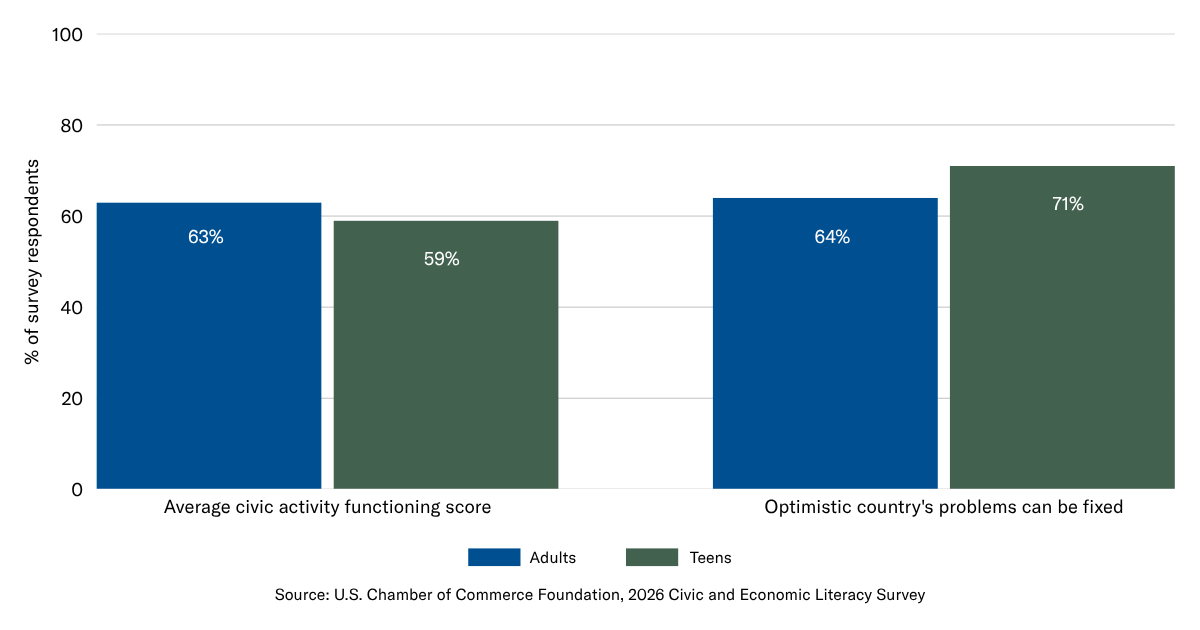
Exhibit 1: Teens rate the country's civic health slightly lower than adults do yet report higher optimism that the country's problems can be fixed. The average civic activity functioning score is the mean percentage of respondents who reported that the United States is performing well across ten civic activities.
Youth Civic Interest: Community vs. Political Engagement
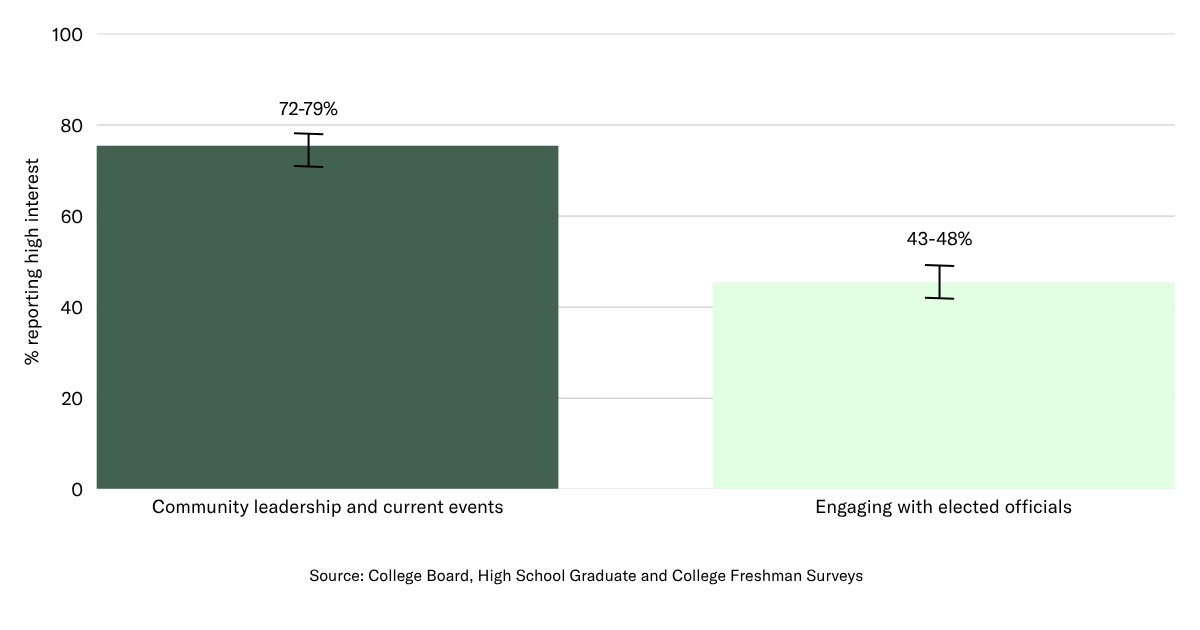
Exhibit 2: Among high school graduates and college freshmen, interest in community leadership and current events (72-79%) far outpaces interest in engaging with elected officials (43-48%).
A Knowledge and Engagement Gap, Not Lack of Interest
The U.S. Chamber Foundation's survey also found real gaps in civic and economic knowledge. Forty-four percent of respondents failed a basic civic literacy test, and 53% failed a basic economic literacy test. Yet more than 9 in 10 adults and teens said democracy, voting, understanding how government works, and supporting local businesses matter to the country's success, and 89% said civics education is important.
To help close this gap, the U.S. Chamber Foundation launched Civics@Work, a nonpartisan initiative that provides employers with tools and resources to strengthen civic knowledge and engagement among employees. One of its flagship programs, Civics Academy, combines civics education with opportunities to build skills such as critical thinking, communication, and collaboration through an online learning experience. The program reflects the idea that civic learning and workplace readiness can be strengthened together, helping employees become both more informed citizens and more effective contributors in their communities and workplaces.
Practical barriers, not a lack of interest, appear to be a real part of the gap. For example, the U.S. Chamber Foundation study found that only 66% of adults knew that a jury summons must be answered even if the recipient believes they cannot serve. Removing logistical, financial, and informational barriers to participation, rather than trying to shift people's underlying values, is where the research points for the most direct impact. Civics@Work’s Juror Education Project is designed to address exactly these kinds of practical barriers by helping employees better understand the jury process before they are called to serve. The project leverages the moment an individual receives a jury summons as an opportunity for civic learning and preparation. Through employer-provided resources, educational materials, and A Juror’s Journey, a 35-minute interactive online simulation, participants learn what to expect from summons to verdict, how juries function, and why representative jury participation matters to a fair justice system.
College Board's research also highlights that both high school and college students reported interest in civic engagement that outpaces actual engagement in specific activities; for example, while 54% of college students indicated they were highly interested in participating in community activities, only 46% said they were actually currently doing so. More than two-thirds of high school graduates and college freshmen rated perspective-taking, openness to challenge, and discussing controversial issues as personal strengths, while they rated their peers far lower on the same measures, in some cases by 30 points or more. Further, they expressed a higher likelihood of engaging with and collaborating on problems with peers who they perceived as similar to them than different from them. Taken together, these findings suggest young people believe in these civic skills, but don’t always perceive that people around them are also practicing these same skills.
To help shift the knowledge and practice gap, both organizations offer options for young people to help generate both an interest in civics and offer the opportunity to build foundational skills that foster career readiness that can help students excel in their communities and drive interest in civics engagement. The U.S. Chamber Foundation offers the nonpartisan National Civics Bee® each year that inspires young Americans to engage in civics and contribute to their communities. Students in grades six through eight who participate in the National Civics Bee gain knowledge about American democracy, practice engaging respectfully and constructively, and build trust in others and institutions. As they compete for prizes, students strengthen their civics, writing, and public speaking skills, and form friendships with other young leaders along the way.
College Board offers advanced coursework for high school students who are interested in deepening their civic knowledge and building valuable, durable skills that prepare them for a successful life beyond the classroom. Through the Advanced Placement program, students can explore AP US Government and Politics to cultivate their understanding of U.S. government and politics through analysis of data and text-based sources as they explore topics like constitutionalism, liberty and order, civic participation in a representative democracy, competing policy-making interests, and methods of political analysis. In AP Business with Personal Finance, students explore the business disciplines of entrepreneurship, marketing, finance, accounting, and management through real-world business application, case studies, and project-based learning. In addition, students learn and apply all the National Standards for Personal Financial Education created by the Council for Economic Education and the Jump$tart Coalition for Personal Financial Literacy.
Students Find Both Career and Civic Benefits in their Educational Experiences
College Board’s research demonstrates that students recognized that their educational experiences served multiple roles: preparing them for both careers and community engagement. Seventy-six percent of high school graduates agreed their coursework prepared them for both a future career and good citizenship, suggesting they already experience the two as linked rather than competing. When college freshmen were asked how important various outcomes of attending college were to them, they also indicated that there were both career- and civic-focused benefits: 95% of respondents rated “skills/training to get a good job” as a valued outcome and 92% of respondents indicated gaining “a greater understanding of the world around me” was important.
The skills explored in College Board’s research also have value that extends beyond active civic life. Employers consistently rank collaboration across diverse viewpoints, communication, and critical thinking among the competencies they most want in new graduates (National Association of Colleges and Employers, 2019, 2025). High school courses such as AP® Research or AP® Seminar, the two courses that make up the AP Capstone® program, allow students to spend the year practicing exactly what employers say they need most: framing a question, weighing evidence, building an argument, and working through it with other people. In this study, AP students who took these courses reported the highest civic interest and engagement when compared to AP students who took other AP courses, particularly when it came to interest in staying informed, evaluating information, and engaging with civic and political life. Those are the same competencies both surveys identify as in short supply nationally, and the same ones that show up on employers' lists of what new hires lack. The pattern suggests that civic and career readiness are not two things schools have to choose between. When a course is built around research, argument, and collaboration, it appears to build both at once, as a byproduct of doing academic work well.
What This Means for Business, Education, and Policy Leaders
Taken together, the two organizations' research findings point toward a shared agenda: young people already bring interest and optimism. What is missing are opportunities to deepen civic knowledge, low-friction pathways to participate and engage with peers in a nonpolitical context, and coursework and workplace programs that build civic and career skills side by side rather than treating them as competing priorities. For business leaders building tomorrow's workforce, education leaders designing tomorrow's coursework, and elected officials shaping the civic infrastructure young people will inherit, the data suggest the same starting point: meet this generation's optimism with the tools to act on it.
About the Research
College Board's findings draw on its 2025 High School Graduate Survey and 2026 College Freshman Survey, covering nearly 47,000 members of the high school graduating class of 2025 and roughly 17,500 of the same cohort surveyed again as college freshmen. The U.S. Chamber of Commerce Foundation's findings draw on its 2026 Civic and Economic Literacy Survey, which measures civic and economic knowledge, attitudes, and behavior among American adults and teens.

About the author
Liane Paonessa
Liane Paonessa is director of AP strategic communications, program communications, engagement and reach at College Board.